

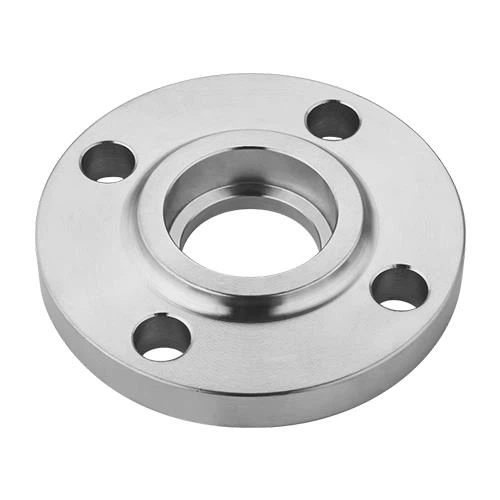
 Product Name:ASME Socket Welding Flange
The socket weld flange refers to a flange that is inserted into the flange ring step at the end of the pipe and welded at the pipe end and the outside. There are two types of neck and no neck. The neck flange has good rigidity, small welding deformation and good sealing performance.
The basic shape of the socket flange is the same as that of the flange with neck flat welding. That is to say, there is a section of socket on the inner hole of the flange, the pipe is inserted into the socket and welded, and a circle of weld is welded on the back of the flange. Because there is a gap between the socket flange and Gou, it is easy to produce corrosion. If another weld is welded inside, this corrosion can be avoided. The fatigue strength of the socket flange welded on both sides is 5% higher than that of the flat flange, and the static strength is the same. When this kind of socket flange is used, its inner diameter shall be the same as that of the pipe. Socket flange is only applicable to pipes with nominal diameter less than 150.

Hot Tags: asme socket welding flange, China asme socket welding flange manufacturers, high temperature ball valve, high quality carbon steel flanges, ball valve commissioning, forged distribution conveyor flanges, ball valve customer support, powder coated flanges
 Q: Can you provide drawings and technical data?
A: Yes, our professional technical department will design and provide drawings and techical data.
Q: Can you do OEM for me?
A: We accept all OEM orders,just give us your design,we will offer you a reasonable price and make samples for you ASAP.
Q: Do you provide samples? Is it free or charged?
A: Yes, we can offer sample free but freight charges covered by customer.
Q: How long is your production lead time?
A: It depends on product and order qty. Normally it takes about 15-30days for an order after we receive your PO deposit.
What are the three major elements of the solid solution of stainless steel flanges? What effect will the solid solution of stainless steel flanges have on stainless steel flanges?
One, solid solution temperature. According to the characteristics of the chemical composition of stainless steel, the solid solution temperature of stainless steel must be 950-1150 degrees Celsius to achieve the softening effect, so that the hardness of stainless steel can be reduced to less than 220HV, and the quality requirements of flange installation and compression can be met. If the temperature control is unreasonable, various quality defects are prone to appear.
Two, solid solution time. During the heating process of austenitic stainless steel, the residual ferrite content in the steel decreases with the extension of heating time. Therefore, the solution treatment of stainless steel flanges should be controlled at about 1050°C to make the carbon saturated and improve the corrosion resistance. Then it is quickly cooled in the air to achieve the solid solution effect.
Three, solid solution speed and heat preservation. The thermal conductivity of stainless steel is low, and the thermal conductivity is only 27% of carbon steel at room temperature. Therefore, the heating process of stainless steel should be slow when heating at low temperature. If the heating speed is too fast, deformation is easy to occur, the stainless steel heating speed should be controlled in the solid solution, and the holding time should be paid attention to. For example, if 316L steel is around 1100℃, the holding time is long, and the content of residual ferrite will continue to decrease.


